江西理工大学马胜灿教授团队small | 热电领域取得的重要进展
近日,江西理工大学金属磁性材料与器件江西省重点实验室马胜灿教授团队在著名期刊Small(If=12.1),在线发表题为《High Thermoelectric Performance in Self-synthesized NiSe/ AgBiSe2 Heterostructured Composites by Doping Ni in n-Type AgBiSe2》的研究论文。该研究团队提出了一种低浓度掺杂诱导原位自生的第二相复合工程策略,通过向AgBiSe2中引入低浓度的镍(Ni)元素,成功构建了均匀分布的NiSe/AgBiSe2异质复合结构,实现了电输运性能和热输运性能的协同优化,显著提升了材料的中温区热电性能。博士研究生邱潮欣为该论文第一作者,马胜灿教授为通讯作者,江西理工大学是唯一完成单位和唯一通讯单位。该研究得到国家自然科学基金及江西省科技计划等项目支持。
该研究中,通过镍掺杂方法实现了自组装NiSe/AgBiSe2异质结构复合材料,从而协同优化了电学和热学输运性能。电导率(σ)的显著提升主要归因于载流子浓度(nH)的显著增加(~6.3 × 1019 cm-3),这来源于硒空位(VSe)、电荷转移以及Ni2+电子掺杂的共同贡献。此外,NiSe第二相引起的能量依赖性选择散射效应促进了电导率(σ)和塞贝克系数(S)的有效解耦。DFT计算结果进一步证实多种非平庸的能带结构共存的NiSe半金属(狄拉克点、平带)可有效减小基体带隙并贡献导带底的态密度有效质量(m*),这使得功率因子(PF)显著提高。例如,Ag0.94Ni0.06BiSe2的功率因子最高达到约4.9 μW cm-1 K-2,相较于原始AgBiSe2提升了98.6%。由于晶界、位错、NiSe第二相和点缺陷等多尺度缺陷的存在,热输运性能受到显著抑制,从而导致Ag0.985Ni0.015BiSe2获得超低的总热导率(κT ~0.35 W m-1 K-1)和晶格热导率(κL ~0.17 W m-1 K-1)。功率因子(PF)和总热导率(κT)的协同优化共同将Ag0.985Ni0.015BiSe2的热电优值(ZT)提升至约1,增长了129%。此外,在ΔT = 500 K的温差下,最大理论热电转换效率(ηmax)达到了约5.72%。另外,少量镍替代银所引入的弱铁磁性可以同时调控电导率(σ)和塞贝克系数(S),这突显了自旋熵不可忽视的影响。在这项研究中,采用第二相复合材料来调控热电性能,为开发高性能n型AgBiSe2基热电材料提供了一种新颖的策略。
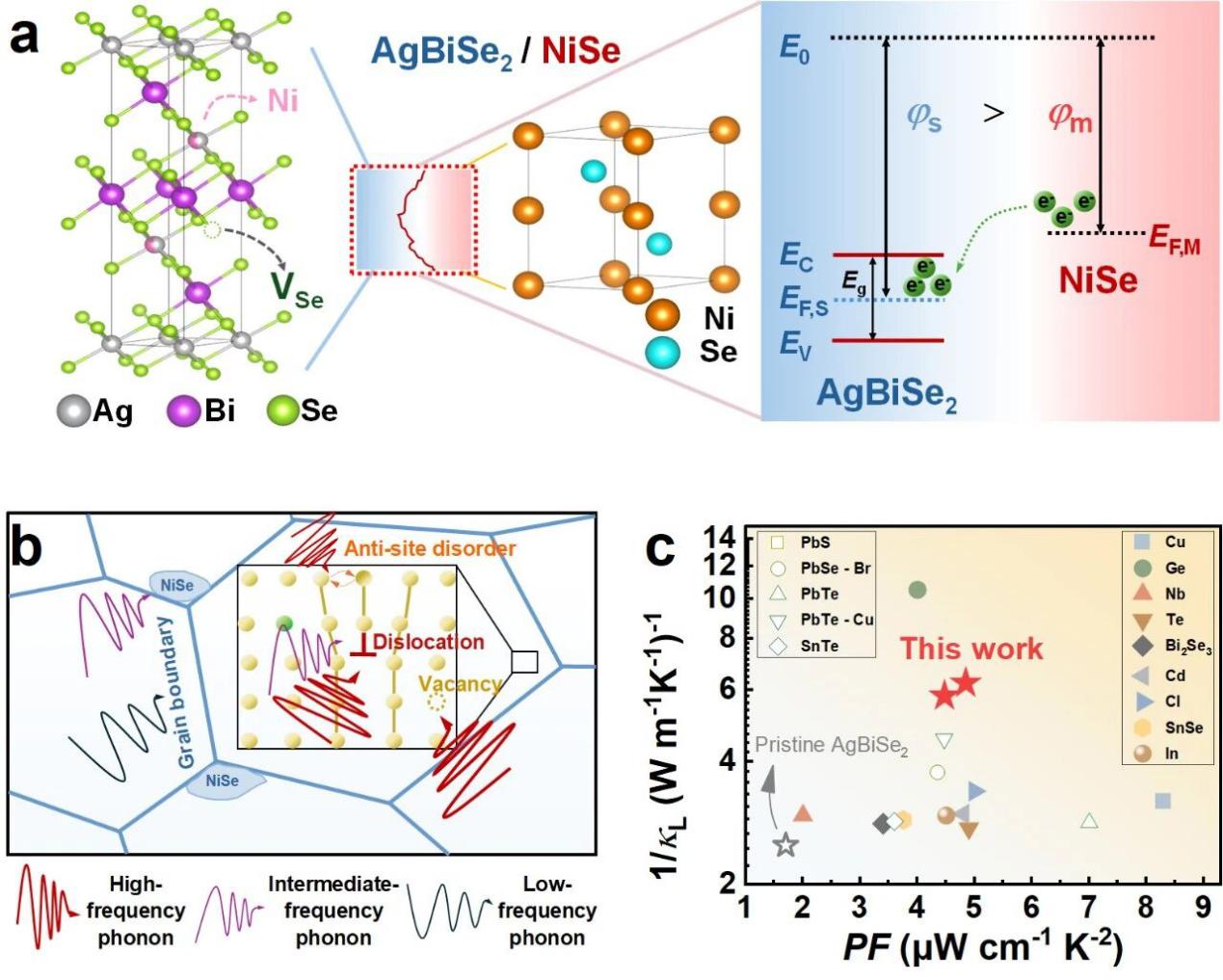
Figure 1. Synergistic control of the carrier and phonon transports via interfacial strategy. a) Schematic illustration of the doping and arrangement of composites employed for our AgBiSe2/NiSe, samples along with the charge transfer NiSe to the matrix. b) Schematic depicting diverse mechanisms for phonon scattering. c) The comparison of the PF and the corresponding value of 1/κL at the ZTmax point with different dopants, including IV-VI elemental doping by entropy-engineering (open symbols) and conventional electron doping (solid symbols
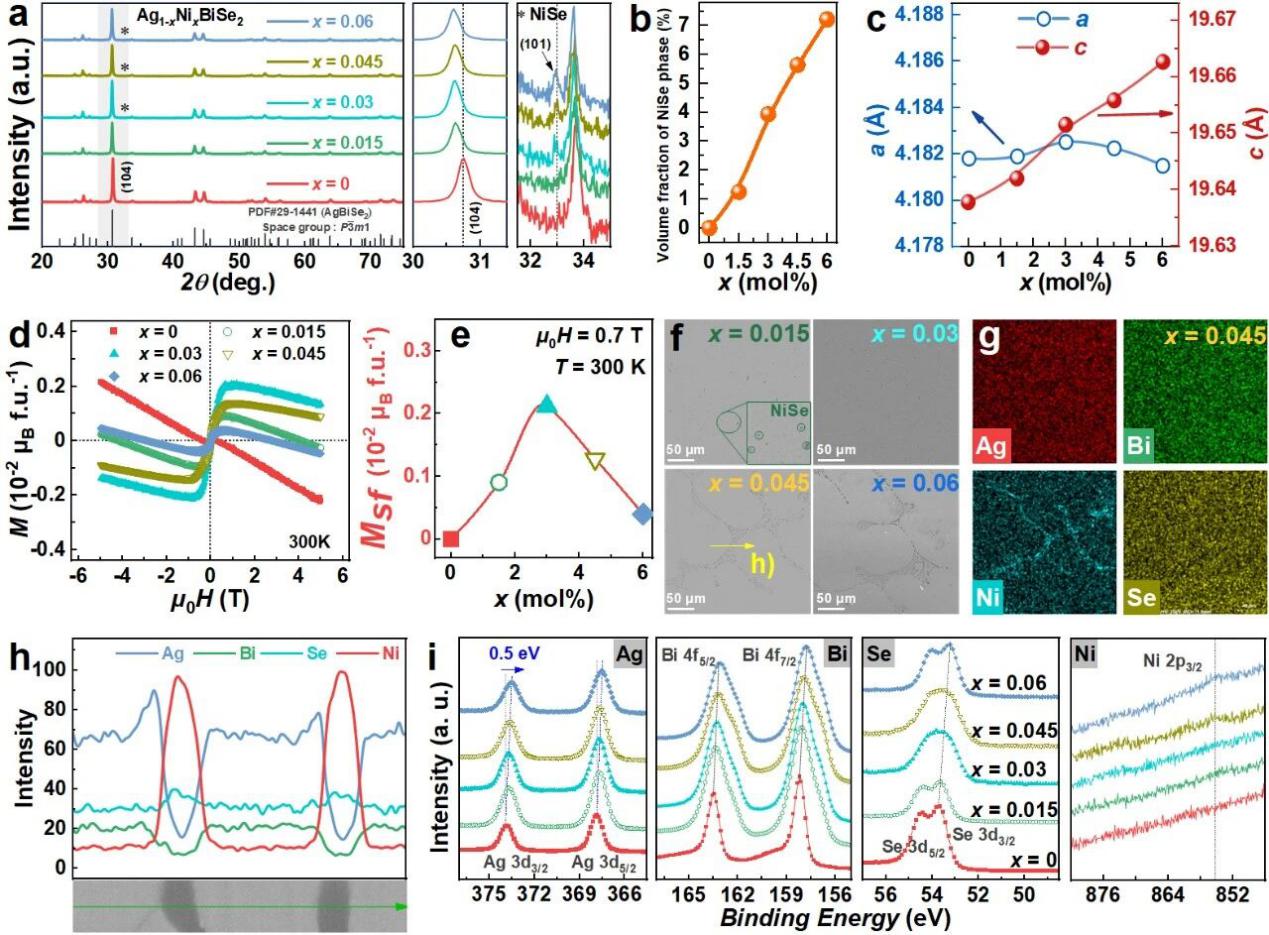
Figure 2. Structural, compositional, magnetic and chemical properties of the as-sintered Ag1-xNixBiSe2 samples (x = 0, 0.015, 0.03, 0.045 and 0.06). a) PXRD patterns collected over a 2θ range of 20° – 75°, showcase a shift in the (1 0 4) peaks of the matrix phase (magnified view) along the appearance of characteristic (101) peaks of the impure phase NiSe (magnified view). b)The volume fraction of NiSe phase in composites, calculated by XRD refinement. c) Calculated lattice parameters as the function of Ni contents x. d) Isothermal magnetizations (magnetization Mvs external magnetic field H plot) measured at 300 K. e) Saturated magnetization per formula unit Msf obtained under 0.7 T at RT. f) SEM-BSE images of Ni doped AgBiSe2 samples, indicating the increasing density of the second phase with Ni content. g) Elemental mapping for Ag,Ni, Bi and Se element. h) Line scan corresponding to the yellow arrow in f) to exhibit the evolution of elements in x = 0.045 sample. i) XPS survey spectra for all specific elements including Ag, Bi, Se, Ni.
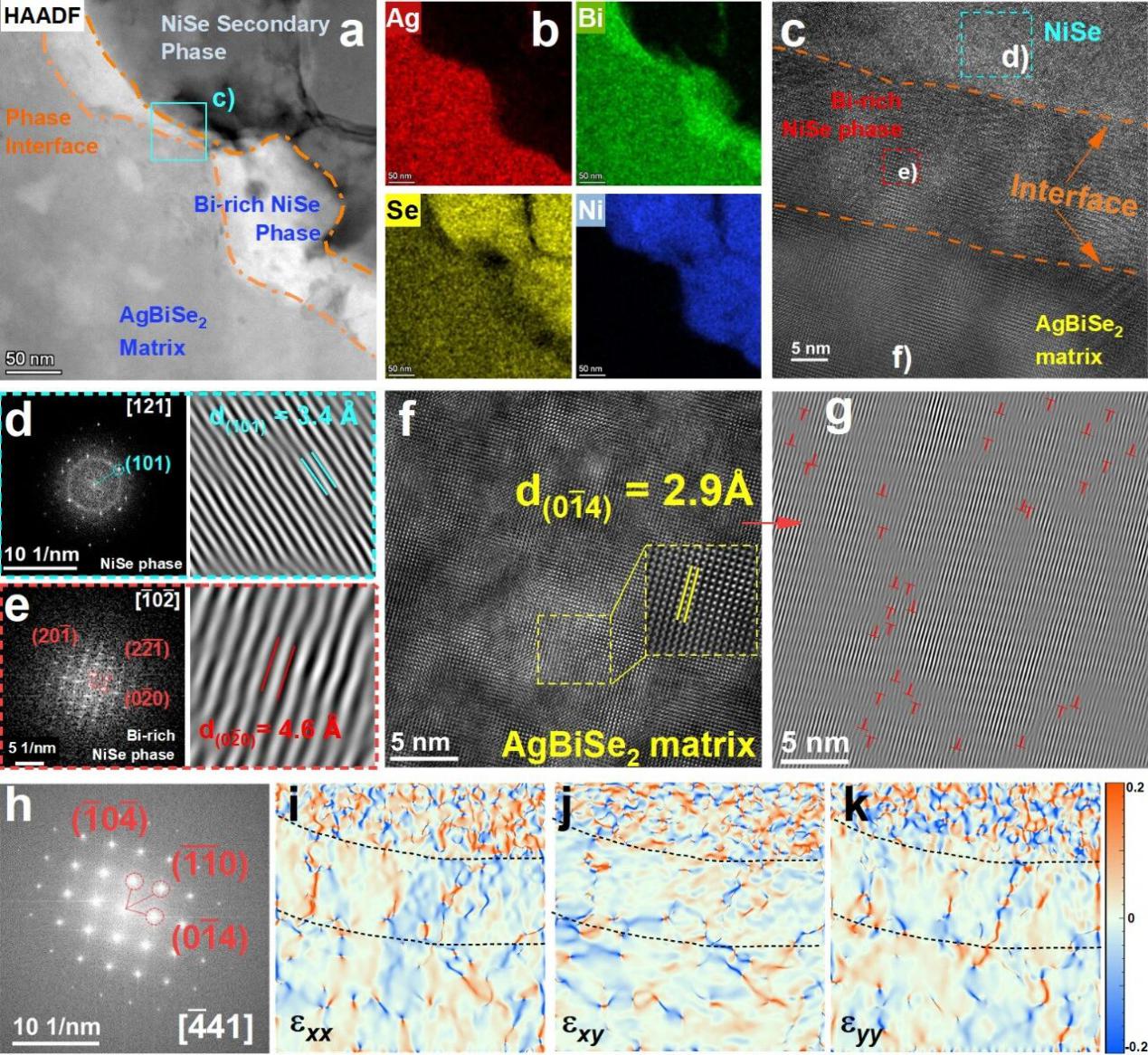
Figure3. Microstructures analysis of Ag0.985Ni0.015BiSe2 material characterized by STEM. a) High-angle annular dark field (HAADF) scanning transmission electron microscopy (STEM) image showing a transition region exist between NiSe second phase and the matrix. b) Energy dispersive spectroscopy (EDS) mapping demonstrating the transition region of Bi-rich NiSe inclusion. c) HRTEM image of the interface between the matrix and NiSe second phase from the region c in a). d-e) FFT and IFFT images for the boxed regions d and e in c), which are calibrated as NiSe and Bi-rich NiSe, respectively. f) HRTEM image of the arrowed area (approximately 25 nm3) in c) showing the Ni doped AgBiSe2 matrix with the corresponding interplanar distance of  plane. g -h) IFFT and FFT images from the square area of f), indicating high dislocation density along the
  zone axis. i-k) Strain mapping of c) along xx, xy and yy directions, respectively, confirmed by geometric phase analysis (GPA).
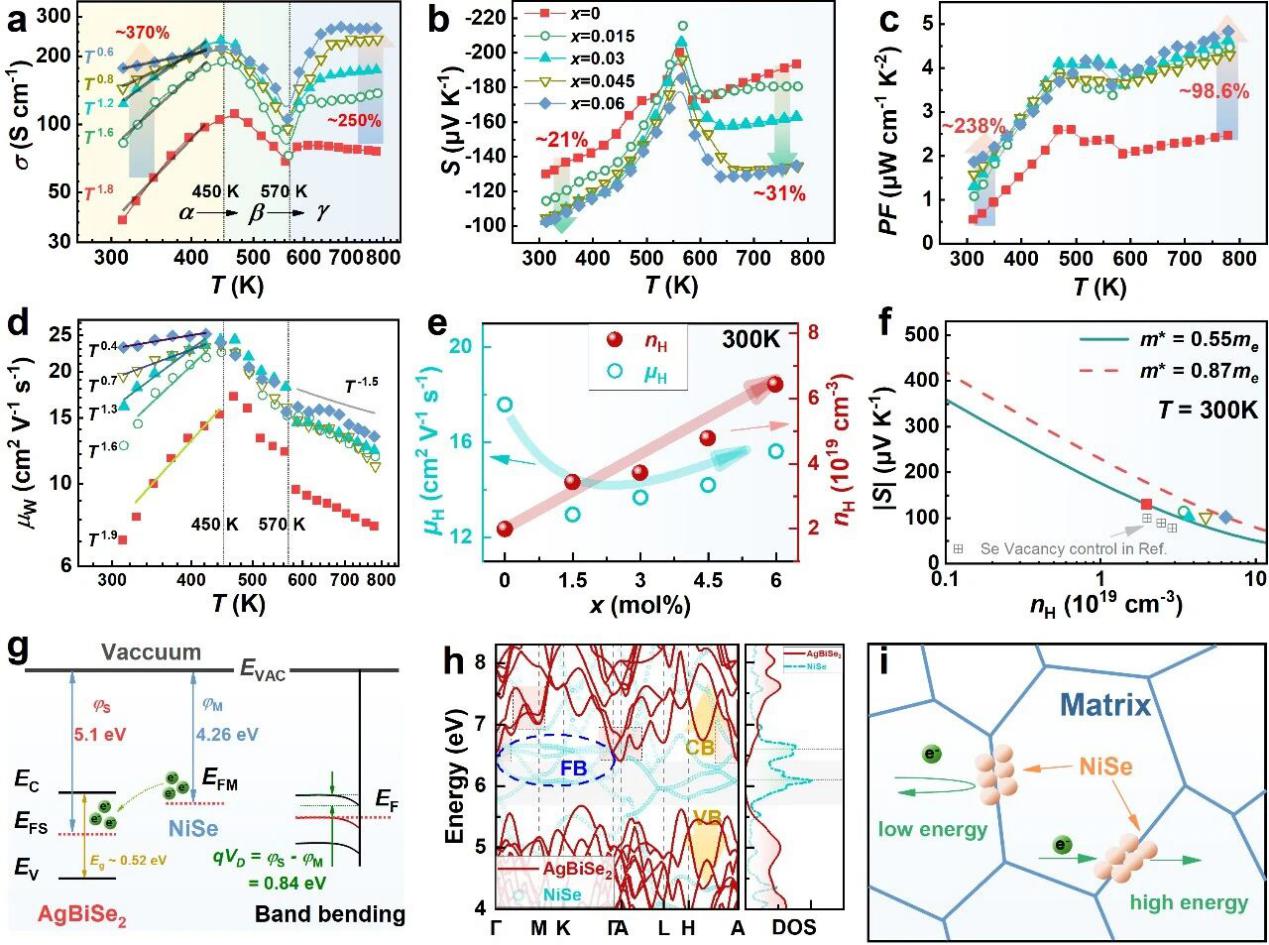
Figure 4. Thermoelectric properties of Ag1-xNixBiSe2 composites. a-d) Temperature dependent electrical conductivity σ, Seebeck coefficient S, Power factor PF and weighted mobility μW (double logarithmic coordinate). e) x dependence of Hall mobility μH and carrier concentration nH at 300 K. f) nH dependent |S| at 300 K obtained by the Pisarenko relation. g) Schematic illustration of the electron transfer from NiSe to matrix. EVAC denotes the vacuum energy level, while EFS and EFM represent the Fermi levels of AgBiSe2 and NiSe, respectively. EC and EV correspond to the conduction band minimum and valence band maximum, respectively. The contact potential difference (qVD) at the interface determined by the work functions of AgBiSe2 (φs) and that of NiSe (φm). h) Projected band structures and electronic density of states for AgBiSe2 (EF = 5.9 eV) and NiSe (EF = 7.98 eV).Multiple non-trivial features exhibited in the band structures of NiSe, including flat bands (FBs, blue dashed ellipses) and Dirac points (Figure S15).Red dashed boxes denote the spatial and energetic overlap between the two bands. i) Electron scattering as a result of band bending at the interface, where the high-energy electrons are unaffected, but the low-energy electrons can be strongly scattered.
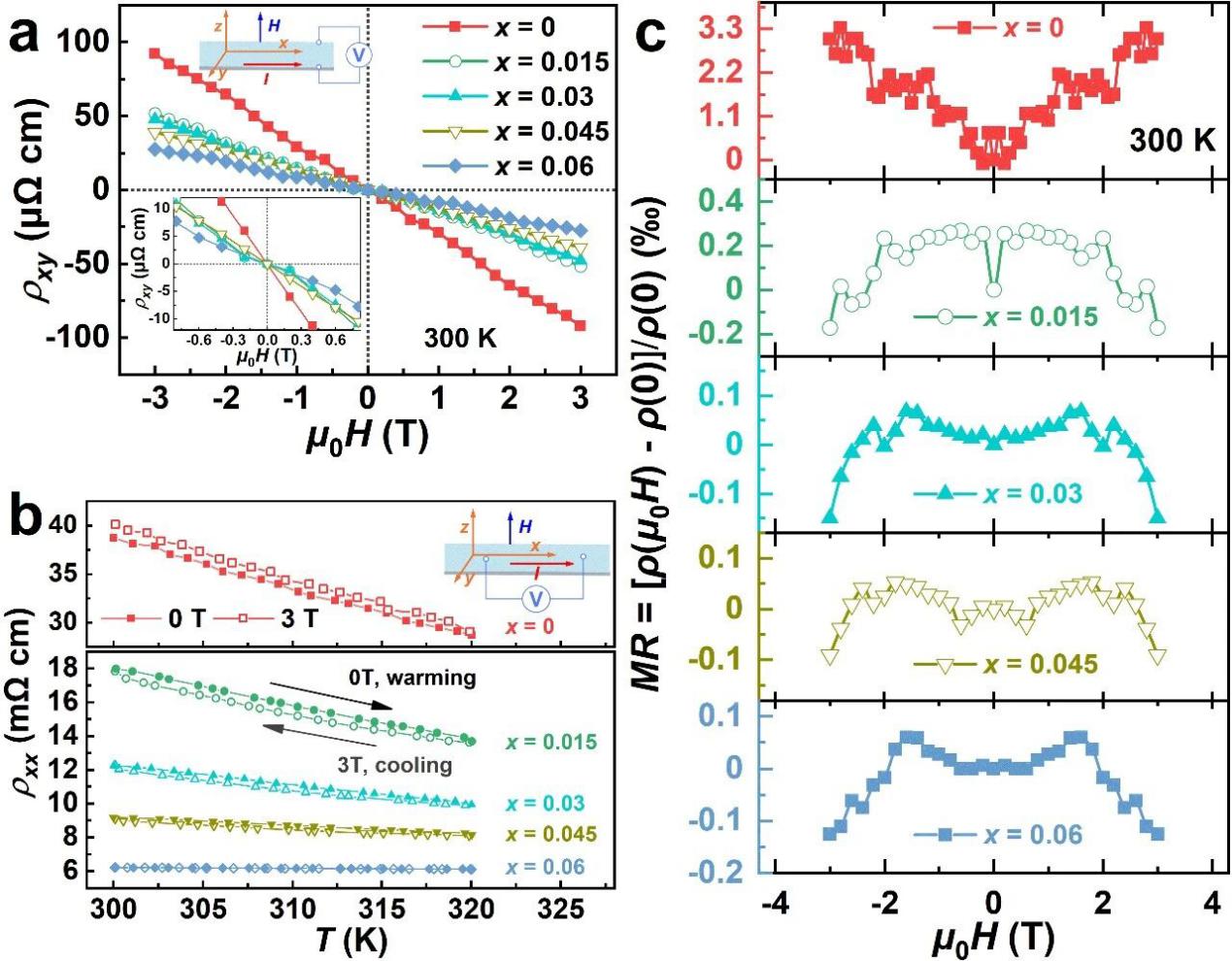
Figure 5. The electrical transport properties influenced by magnetism. a) The magnetic field dependent ρxy by Hall measurements under the magnetic field in ±3 T. b) Temperature dependence of resistivity ρxx before and after magnetization. Solid and open symbols denote data acquired upon warming without magnetic field and upon cooling under 3 T applied magnetic field, respectively. The geometric sketches of measurements are shown in the inset of (a, b). c) The magnetic field dependent magnetoresistance, MR (‰), measured under ±3 T applied field.
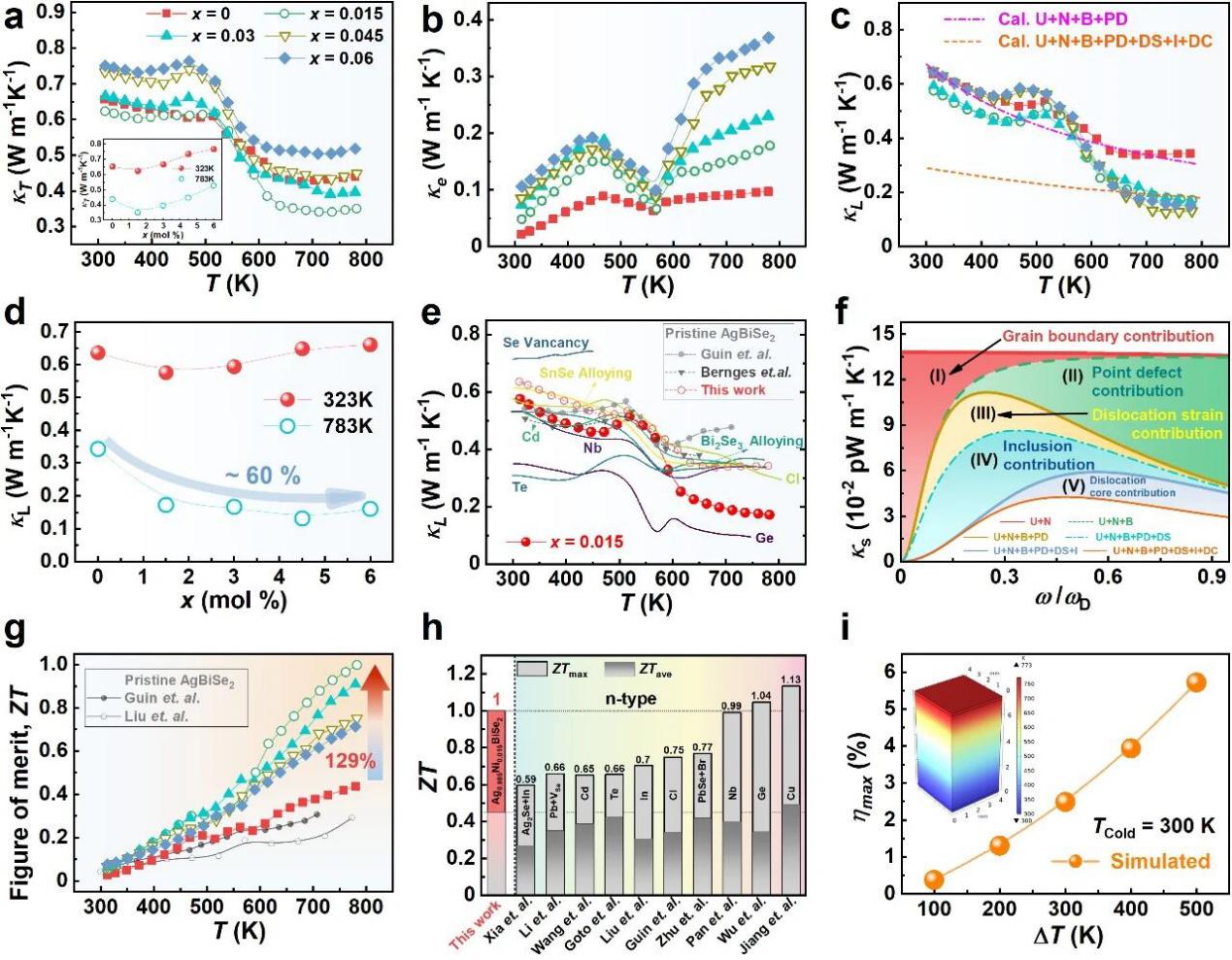
Figure 6. Thermal transport properties and figure of merit ZT for Ni-doped AgBiSe2 samples. a-c) Temperature dependence of total thermal conductivity kT, electrical thermal conductivity ke and lattice thermal conductivity kL, the purple and orange dashed lines are the calculated results via the Debye-Callaway model for x = 0 and x = 0.015 samples. d) Ni content x-dependent kL at 323K and 783 K. e) Comparison of ultra-low kL with literature data. f) Calculated κs for x = 0.015 sample with various phonon scattering. g) Temperature dependent ZT with the comparison of pristine AgBiSe2 from literatures. h) Comparison of the average ZT (ZTavg) and maximum ZT (ZTmax) obtained in this work for x = 0.015 sample and those of literature n-type AgBiSe2-based materials. i) The COMSOL simulated efficiency max of the x = 0.015 sample.
文献链接:
https://onlinelibrary.wiley.com/doi/10.1002/smll.202513903
通讯作者介绍:江西理工大学马胜灿教授,长期致力于稀土磁性材料研究,已发表SCI论文100余篇,获授权国家发明专利10余件,主持国家及省部级项目10余项,曾以第一完成人获江西省自然科学奖一等奖,并荣获江西省最美科技工作者等荣誉。自2021年马胜灿教授提出并开展“磁调控热电材料”研究以来,已发表包括Small,Physical Review B,Materials Today Physics,Materials Today Chemistry等相关多篇该领域高档次论文。相关论文:Chaoxin Qiu, Shengcan Ma*, et al. High Thermoelectric Performance in Self-synthesized NiSe/AgBiSe2 Heterostructured Composites by Doping Ni in n-Type AgBiSe2 [J]. Small, 2026, 0(41): e13903. Chaoxin Qiu, Shengcan Ma*, et al. Coexistence of Giant Transverse Transport Properties and Complex Spin Configuration in Polycrystalline Kagomé Ferromagnet GdCo2 [J]. Small, 2025, 21(41): e04495. Ren W, Shengcan Ma*, Large room temperature anomalous Hall and Nernst effects in Kagomé ZrFe2 ferromagnet[J]. Materials Today Physics, 2025: 101838.Chaoxin Qiu, Shengcan Ma*, et al. Large anomalous Nernst effect in polycrystalline topological half-metal Co2CrGa [J]. Materials Today Chemistry, 2025, 45: 102682.Yuyang Han, Chaoxin Qiu, Shengcan Ma, et al. Anomalous Hall and Nernst effects in the half-metallic ferromagnet Gd4Sb3 [J]. Physical Review B, 2024, 110(14): 144405.